Advocate

The Massachusetts FARM Bill needs your support!

Please use this toolkit to reach out to House leadership to ask them to support H.4854, the FARM bill! We need a strong push to get the House to move the bill out of HWM and to the floor for debate – please follow the steps in the toolkit to take action and share this action widely with your networks! The formal session ends on July 31, a rapidly approaching deadline for bills.

Support food system priorities in the environmental bond bill!

The environmental bond bill has been passed by the House and Senate. Now, three members of each chamber; Reps Finn, Barber and Sweezey, and Senators Rausch, Cyr and Durant, have been appointed to a committee to resolve the differences between the proposals. Although the proposals are in alignment on some agricultural programs, they differ on the amount of funding authorized for FSIG, the Healthy Soils Program, the Massachusetts Food Trust Program, and more. The environmental bond bill is only authorized once every five years (the last one was passed in 2018), so this is an important moment to make your voice heard! Please use the Collaborative’s letter as a template, and reach out to Becca with any questions.

Collaborate

Save the date for the 10th annual Massachusetts Food System Forum

Please save November 19, 2026 for the tenth annual Forum! This year’s Forum will be held at the College of the Holy Cross in Worcester.

The Collaborative is actively looking for sponsors to ensure that everyone who wants to come to the Forum can attend without the ticket cost being a barrier. Interested in making a difference and exploring sponsorship? Email Kristina.

State Legislative update

The end of the legislature’s formal session on July 31 is rapidly approaching. Under the legislature’s rules, this means bills have to be passed by both chambers and assigned to a conference committee to still be considered alive to be passed by the end of the calendar year. Please follow the steps in the calls to action above to support the FARM bill and food system priorities in the environmental bond bill!

On June 12, Governor Healey signed a farmer tax credit into law! This tax credit, up to $5,0000 for farmers and aquaculture producers who donate edible food and crops to hunger relief nonprofit organizations, was part of a larger supplemental budget. Now, we are waiting for the Department of Revenue, in partnership with the Mass. Department of Agricultural Resources, to share guidance on how this will be implemented. In the meantime, we suggest farmers save any receipts that track donations to food pantries or other hunger-relief organizations.

In the late evening of June 30, 2026, the fiscal year 2027 budget conference committee report was released. This budget proposal was passed by the House and Senate on July 1, and is now with the Governor for her review, any vetos, and her signature. The Collaborative appreciates the leadership of Chairs Michlewitz and Rodrigues, Vice-Chair Comerford, and Senate President Spilka and Speaker Mariano is creating this budget that continues to support the local food system.

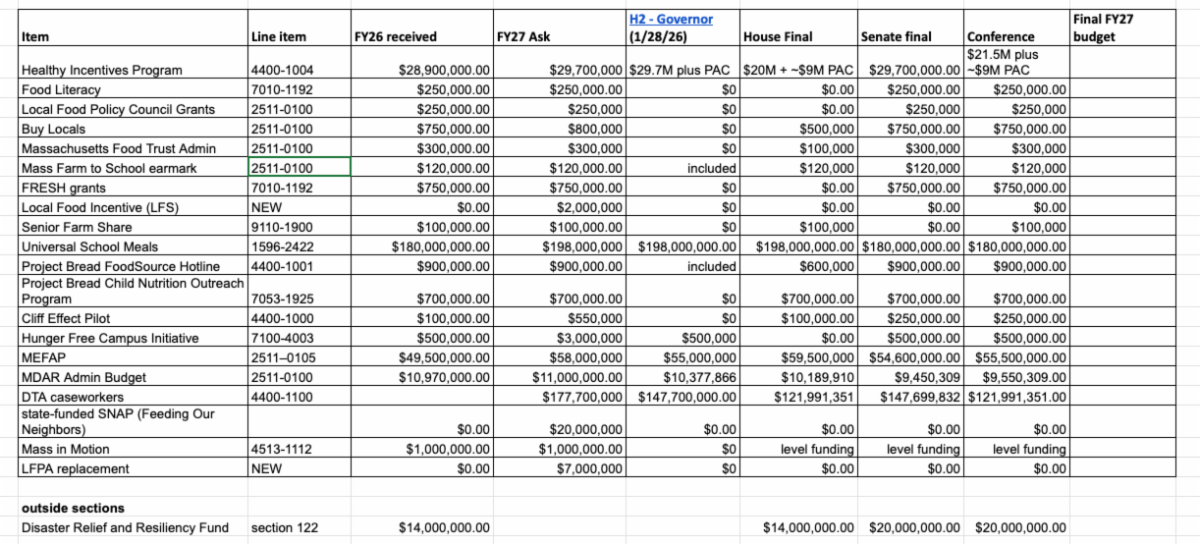
The final proposal (pending any vetos from the Governor) includes; $21.5 million for HIP, plus a commitment to carry forward $9 million of unspent funds from FY26 for a total of $30.5 million available in FY27, $1 million for food literacy ($750,000 for the FRESH grant program, $150,000 for the School Wellness Coaching Program, and $100,000 for curricula and resource development), $250,000 for the local food policy council grant program, and $20 million for the Disaster Relief and Resiliency Fund. Unfortunately, the budget includes a $500,000 cut to MDAR’s administrative budget, underfunds DTA’s caseworker line item, and does not include a state-funded LFPA program. We are concerned about these cuts impacts on the state agencies and are working with our statewide anti-hunger partners to address the SNAP access crisis. Thank you to the hundreds of partners who took action during this budget cycle to make the impact of these programs known. Our collective work is powerful, and results in real progress.

The chart below includes additional programs that are the priorities of our partners.

Finally, the economic development bond bill, H.5562, will be debated by the Massachusetts House on July 8. This proposed bond bill includes $10 million for grants for food science and agricultural tech, to be distributed by the Executive Office of Economic Development. The bond additionally includes a policy section requiring the Department of Public Health to develop regulations for the annual health inspection of food trucks. Standardizing food truck inspections is an area former Collaborative staff member Brittany Peats worked on and developed recommendations around several years ago, and we are glad to see this idea finally moving forward. More than 600 amendments have been proposed by Representatives, and we will share updates on the bond bill’s progress and its relation to the local food system.
Federal update

The U.S. Senate Committee on Agriculture, Nutrition, and Forestry released its draft Farm Bill on June 24, 2026. It does not increase support for small, diversified farms that are prevalent in the Commonwealth, does not include mandatory funding for LFPA, and does not delay the implementation of the SNAP cost-share provisions passed by Congress in OB3 one year ago. Read more from the National Sustainable Agriculture Coalition here.

Network updates

The Campaign for HIP Funding met on July 7. The Campaign is encouraging HIP vendors and partners to celebrate the program reaching $100M of incentives earned since the program began this summer! This is a huge milestone for the program and HIP is the first nutrition incentive program to reach this amount nationwide. See this toolkit for more information, and reach out to Becca with any questions.

The Campaign for Food Literacy – unfortunately, the House Education Committee sent H.735, An Act to Promote Food Literacy, to study this session. The Campaign will meet next on August 4 to begin discussing advocacy strategy for the 2027-2028 legislative session.

The Urban Agriculture Network will not meet virtually in June & July, but many sites are planning to host events and visits during MDAR’s Urban Agriculture Week (August 9-15) and throughout the Summer season. See the site visit schedule here.

The Local Food Policy Councils Network met in June. A number of LFPC’s are in the process of conducting community food assessments and / or are exploring food system resilience and emergency preparedness planning. We will continue this conversation in our July meeting.

The Food Waste Reduction Network will next meet on Tuesday July 14 at 10am. We will be learning about several national initiatives, exploring local, state, and federal policy levers for reducing and managing food waste, and beginning to brainstorm policy priorities for the next legislative session.

To sign up for the listserv for any of these networks to receive further updates, please reach out to Emily Fidanza.

The Agricultural Advocacy Coalition will meet next on July 15 to discuss the FARM bill, educating legislative candidates during this election cycle, and priorities for the next legislative session. Please reach out to Becca for the meeting information.

Celebrate

Public Servant of the Month: DESE’s Nutrition Education and School Wellness Training team in the Office for Food and Nutrition Programs.

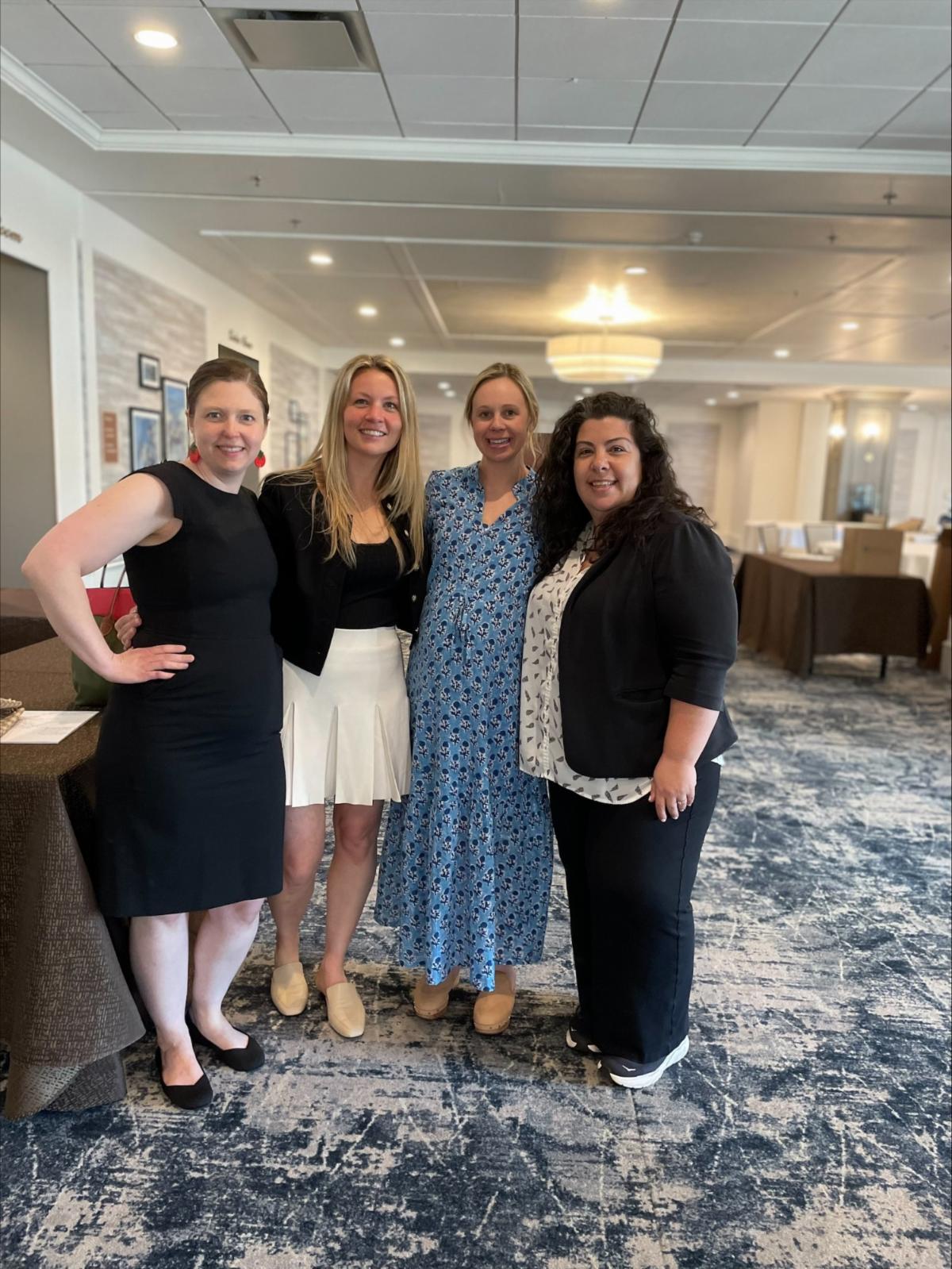
The Nutrition Education and School Wellness Training team at DESE, made up of Denise Courtney, Kelly Burke, and Maggie Nowak, works to support high quality school nutrition programs, including ensuring access to healthy food, uplifting local food, and championing food education. The team manages programs including training for School Nutrition Professionals, the Fresh Fruit and Vegetable Program, Terrific Tray, FRESH grant program, Northeast Food for Schools Challenge, Local School Wellness Policies, and more. Since fiscal year 2023, the Department has implemented $1 million from the state budget annually in food system education, awarding FRESH grants to more than sixty schools and early education programs, working with the John Stalker Institute and RootEd to deliver more than 500 additional hours of food literacy professional development across fourteen distinct course offerings, and providing school wellness policy coaching to more than sixty school districts. FNP staff continue to work across departments, state agencies, and with additional partners to expand resources and offerings that support food education and the local food system.

Interested in being featured in our monthly newsletter? Please fill out this form!

Discover

New Climate Disaster Relief report details additional policies needed for farm safety net

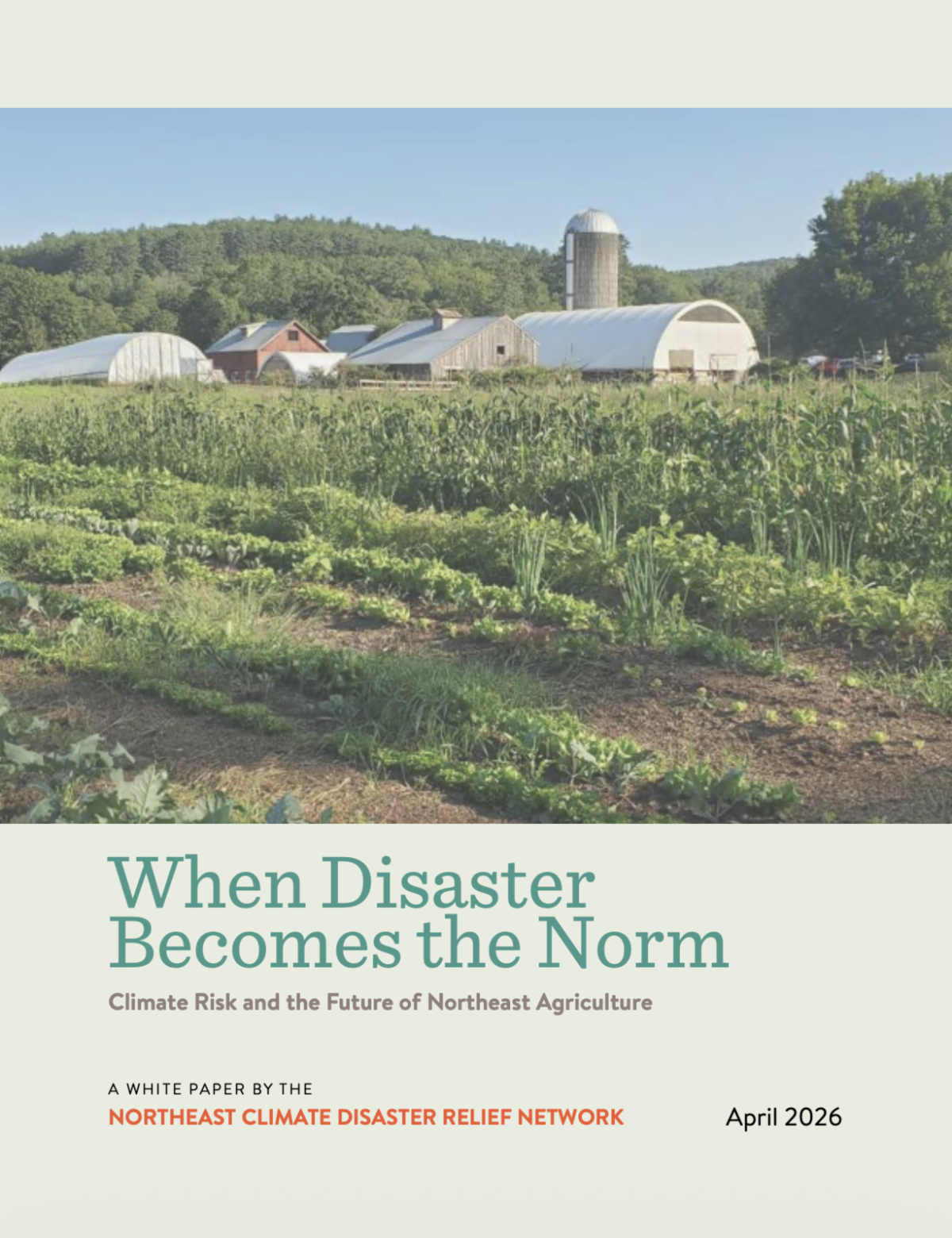
When Disaster Becomes the Norm, a new report from the Northeast Climate Disaster Relief Network and FarmAid, was released in June. The white paper explores the ways climate change impacts agriculture, and how inadequate our current farm safety net is when it comes to helping farmers recover from climate disasters. The white paper provides case studies and recommendations for policymakers to address this problem. This is a timely paper as the state begins to draft how the Disaster Relief and Resiliency Fund will be deployed, which covers losses from agriculture, as well as municipalities and other businesses. Read the white paper here.

Share It