In June 2026, Governor Healey signed a fiscal year 2026 supplemental budget into law that included a three-year, refundable, up to $5,000 tax credit for farmers and aquaculture producers who donate excess crops to hunger relief nonprofits. This is thanks to the hard work of Representative Hannah Kane and Senator Comerford, who have advocated [...]
Categories
Featured posts
Fiscal year 2027 budget update
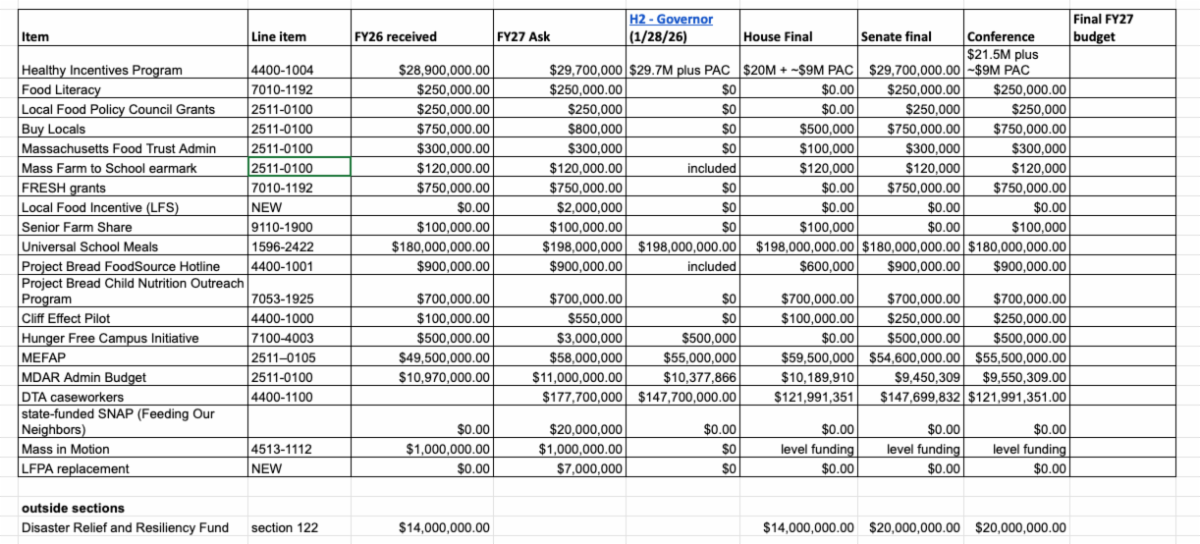
In the late evening of June 30, 2026, the fiscal year 2027 budget conference committee report was released. This budget proposal was passed by the House and Senate on July 1, and was signed into law by the Governor on July 9, 2026 with no vetos or changes. The Collaborative appreciates the leadership of Chairs Michlewitz and Rodrigues, Vice-Chair Comerford, and Senate President Spilka and Speaker Mariano is creating this budget that continues to support the local food system.
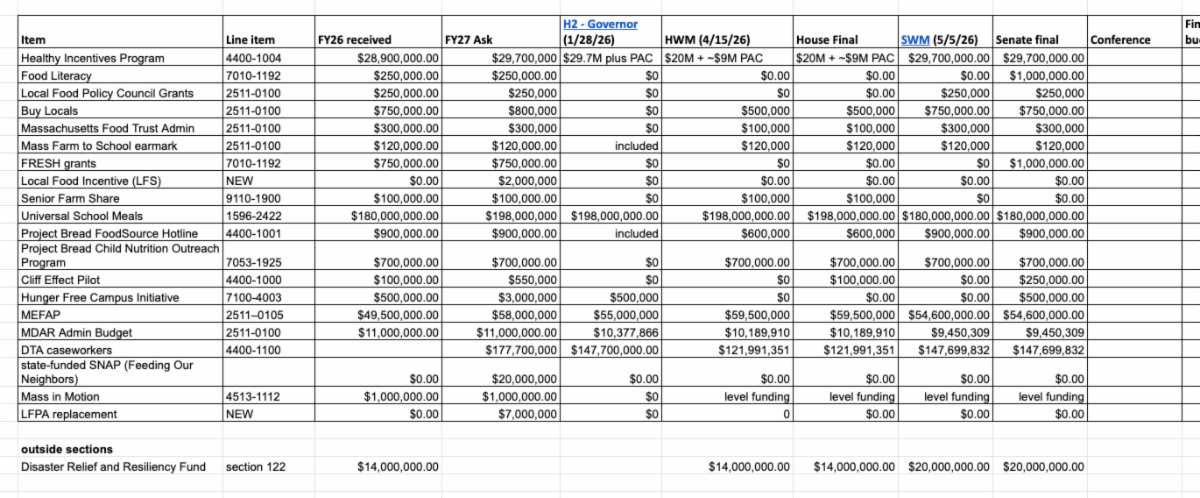
The final proposal (pending any vetos from the Governor) includes; $21.5 million for HIP, plus a commitment to carry forward $9 million of unspent funds from FY26 for a total of $30.5 million available in FY27, $1 million for food literacy ($750,000 for the FRESH grant program, $150,000 for the School Wellness Coaching Program, and $100,000 for curricula and resource development), $250,000 for the local food policy council grant program, and $20 million for the Disaster Relief and Resiliency Fund. The budget also includes $55 million for MEFAP funding for food banks, and $180 million for universal free school meals. Unfortunately, the budget includes a $500,000 cut to MDAR’s administrative budget, and significantly underfunds DTA’s caseworker line item at a time when acess to DTA has plummeted, decreasing access to SNAP for tens of thousands of residents. The budget also does not include a state-funded LFPA program, despite the work of dozens of partners this spring who MAFSC organized a Lobby Day and multiple call-in days with to advocate for this funding. We are concerned about these cuts impacts on the state agencies and are working with our statewide anti-hunger partners to address the SNAP access crisis. Thank you to the hundreds of partners who took action during this budget cycle to make the impact of these programs known. Our collective work is powerful, and results in real progress.
House passes environmental bond bill
On June 17th, the House passed H.5510, the Mass Ready Act, also known as the environmental bond bill. The EBB is introduced and passed by the legislature once every five years (the last one was passed in 2018). Bond bills authorize funding amounts for the state to fund capital grant programs. The EBB was first introduced by the Governor in July 2025, and hearings on the proposal were held by the Committees on Environment and Natural Resources and Bonding, Capital Expenditures and State Assets before being referred to Senate Ways and Means in January 2026, passed by the Senate in April, and then referred to House Ways and Means.
The bond bill as released from House Ways and Means mirrors the Senate and Administration’s proposal with some additions:
- $150M authorization for the Food Security Infrastructure Grant program – a $25M increase from the Senate and Adminsitration
- $26M authorization for CSAP, FVEP, urban agriculture, compost, food safety, Farmland Plan implementation, plus a commitment to carry forward $26.3M of unspent funds from the 2018 environmental bond bill
- $42M authorization for APR, plus a commitment to carry forward $18M of unspent funds from the 2018 environmental bond bill
- An outside section (3) that will distribute the $1 million milk producers security fund and subsequently close the fund.
- An outside section (5 and 6) that adds UMass Extension and the Division of Marine Fisheries to the Massachusetts Food Policy Council.
- An outside section (20) that grants MDAR a right of first refusal, positioned behind a municipality’s, on agricultural land protected under Chapter 61A when it comes up for sale. This is a critical step toward slowing the rate of farmland loss.
- An outside section (48 and 49) that modernizes animal commercial feed regulations.
The House did not include specific earmarks for the Healthy Soils and Mass Food Trust Programs, unlike the Senate. The Healthy Soils program is included in general in a larger line item, it is not zero’d out.
During debate, amendments relating to the food system that were adopted include:
- ATV bill
- A port development commission
Amendments that were not adopted that the Collaborative supported:
- An amendment sponsored by Agriculture Committee Chair Aaron Saunders to create a working capital loan program, to be administered by MDAR in partnership with a CDFI or similarly qualified institution.
- An amendment sponsored by Representative Arena-DeRosa to ban the land application of sludge and create a PFAS Relief Fund for farmers, capitalized with $50 million.
- An amendment sponsored by Representative Duffy to authorize $5 million for the urban agriculture grant program.
- An amendment sponsored by Representative Sylvia to capitalize MDAR’s new Buy-Protect-Sell authority with $10 million.
The differences between the House and Senate bond proposals must now be worked out by a conference committee, and the proposal will then be sent to the Governor for her signature. We will share an update on how to write to the conference committee soon. Bond authorizations are then drawn down into capital budgets (or capital improvement plans), which are set by the Governor’s Administration on an annual or 2 year basis.
June 2026 Newsletter
Advocate

The Massachusetts FARM Bill needs your support!
Please use this toolkit to reach out to House leadership to ask them to support the state FARM bill! We need a strong push to get the House to move the bill out of HWM and to the floor for debate – please follow the steps in the toolkit to take action and share this action widely with your networks! The formal session ends on July 31, which is a rapidly approaching deadline for bills.
Write to FY27 Conference Committee with food system priorities
The Legislature’s conference committee has been appointed as of May 28, 2026, and will spend June hashing out the differences between the House and Senate proposals, for a final version that will be sent to the Governor’s desk by July 1. Please reach out to the Conference committee by June 22 to ask them to support local food system programs like HIP, the local food policy council grant, food literacy, disaster relief, and state agencies including MDAR and DTA in the final budget.
Collaborate
Save the date for the 10th annual Massachusetts Food System Forum Please save November 19, 2026 for the 10th Annual Forum! This year’s Forum will once again be held at the College of the Holy Cross in Worcester.
We have a lot of sponsorship opportunities. Sponsors help to keep our ticket prices low. Interested in exploring opportunities? Email Kristina.
State Legislative update
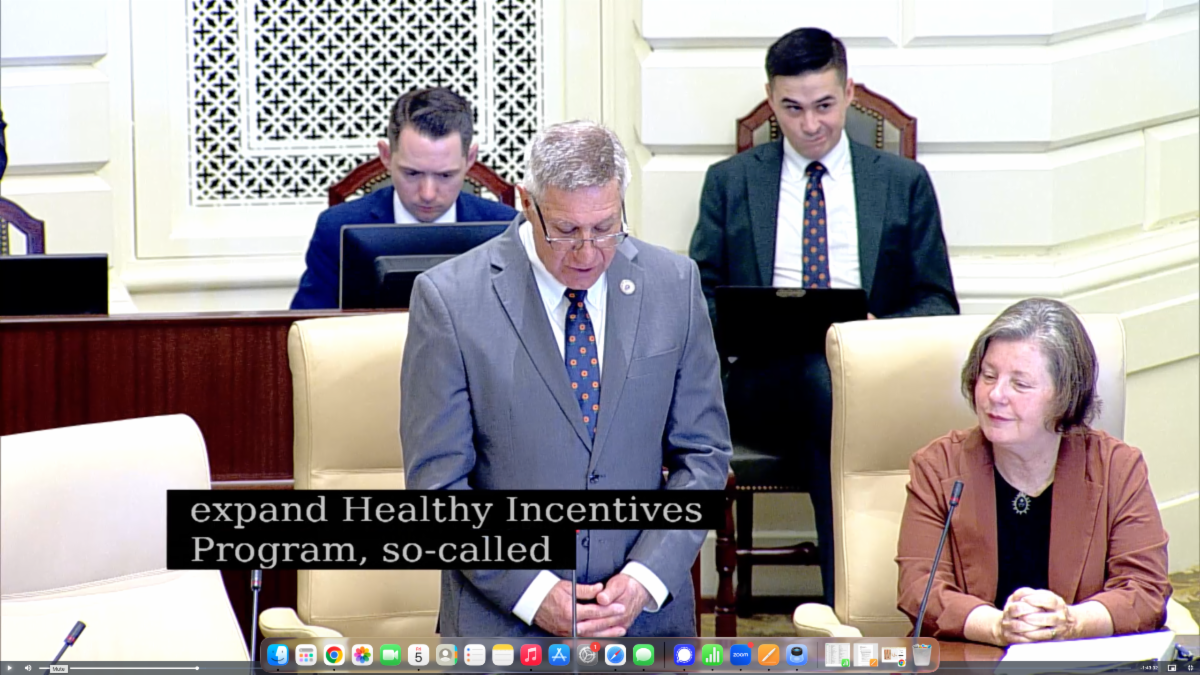
On May 5, 2026, the Massachusetts Senate Ways and Means Committee released its fiscal year 2027 budget proposal. Senate Ways and Means proposed $29.7M in new funding for the Healthy Incentives Program, level to the Governor’s proposal of $29.7M in H.2, and $250,000 for another round of the local food policy council grant program. The Collaborative thanks the Senate for their leadership, especially SWM Chair Rodrigues and Vice-Chair Comerford for mentioning HIP once again in their remarks to open debate. During debate, an amendment for $1 million for FRESH grants and food literacy funding was adopted. For a full recap of the budget process, read this article on our website. .
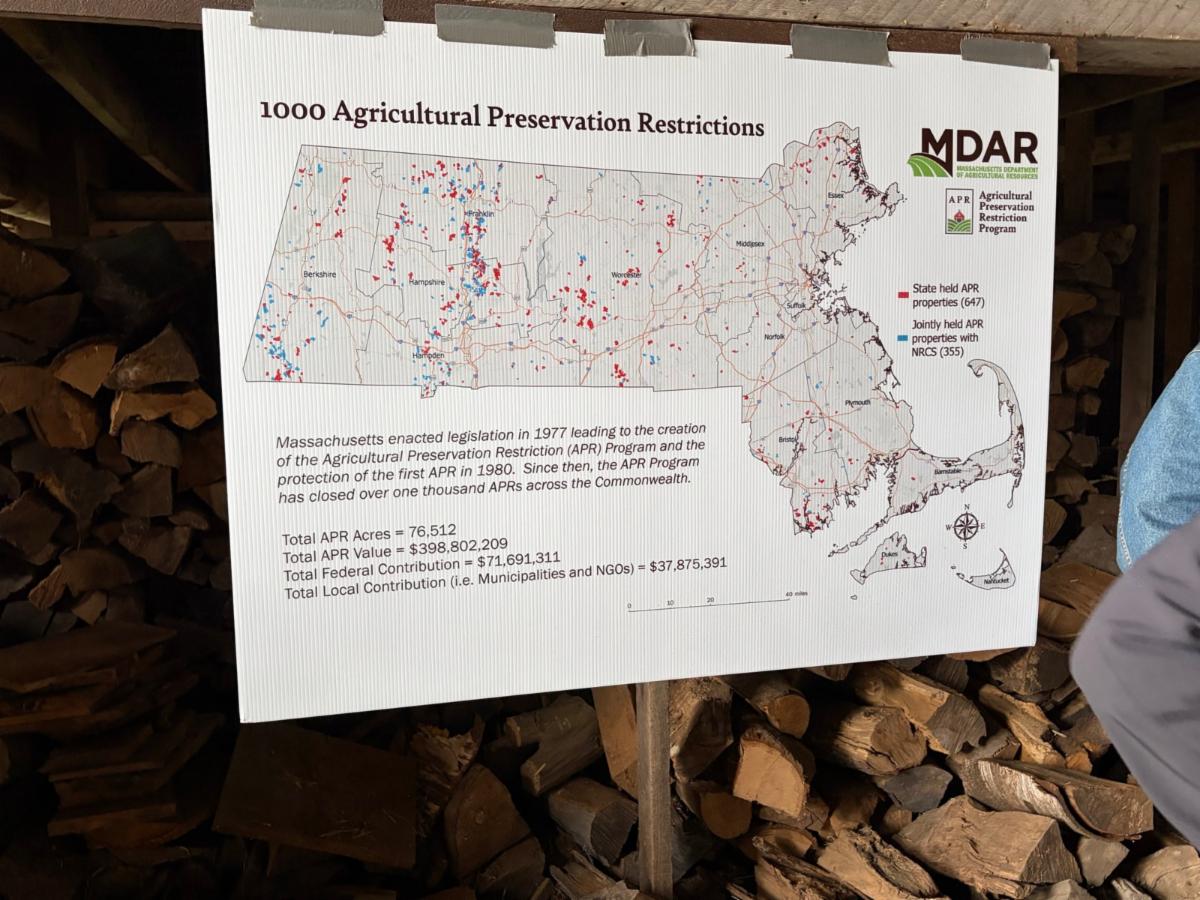
In May, MDAR celebrated the 1000th farm property joining the APR program! The APR program was the first in the nation dedicated to protecting farmland forever, and more than 75,000 acres of farmland have been preserved through the program.
In addition to the annual budget process, the fiscal year 2026 supplemental budget, that includes a $5,000 refundable tax credit for farmers who donate edible food to hunger relief nonprofits policy, has been passed by the Legislature as H.5470 and is now on the Governor’s desk. We will be keeping an eye on this policy after the Governor signs it into law and as it is implemented by MDAR and DOR, so that it is accessible to farmers.
Federal update: SNAP-Ed state funded extension comes to an end SNAP-Ed is the education arm of SNAP (Supplemental Nutrition Assistance Program) and provides direct education on nutrition and fitness to SNAP-eligible adults, children, and families, via demonstrations, classroom lessons, and PSE activities (policy, systems, and environmental change). In Massachusetts, the SNAP-Ed implementing partners include UMass Extension NEP, Ascentria Care Alliance, The Food Bank of Western Mass, and the Greater Boston YMCA. NEP (the Nutrition Education Program) is the largest implementing agency for SNAP-Ed in Massachusetts. Housed in UMass Amherst Extension, NEP partners with community agencies and organizations throughout the Commonwealth. In FY25, NEP collaborated with 259 partner organizations, delivering programming to over 40,000 children and adults in public K-12 schools, community centers, preschools, food banks, and more.
Congress cut the SNAP-Education program in 2025, and although the state stepped up to fund one additional year of the program, that year is now coming to an end. Due to this cut, staff will be laid off in the coming months at the implementing partner agencies, and the availability of nutrition education will be reduced. The funding gap is several million dollars for statewide programming.
Network updates The Campaign for HIP Funding will meet next on July 7. The Campaign is encouraging HIP vendors and partners to celebrate the program reaching $100M of incentives this summer! This is a huge milestone for the program and HIP is the first nutrition incentive program to reach this amount of support.See this toolkit for more information.
The Campaign for Food Literacy met on June 2 at 4pm. We shared the latest legislative and budget updates. We are currently asking food literacy supporters to contact the Conference Committee to urge them to include $1M for farm to school and food literacy in the FY27 budget. This funding supports continuation of the School Wellness Coaching Program, another round of FRESH grants, and the development of food literacy curricula, tools and resources.
The Urban Agriculture Network met in May sharing updates from a variety of urban agriculture work including community farms and gardens, freight farms, youth development, and more. The network will not meet virtually in June & July, but many sites are planning to host events and visits during MDAR’s Urban Agriculture Week (August 9-15) and throughout the Summer season.
The Local Food Policy Councils Network met in May sharing updates about their current work. A number of LFPC’s are in the process of conducting community food assessments and/or are exploring food system resilience/emergency preparedness planning. We will dive more into this topic at our June 11 network meeting. The Food Waste Reduction Network met in May and explored the evolving landscape of food waste prevention, reduction, and management with guest speakers Nate Clark (Senior Communications Manager at ReFED) and Heather Billings (Senior Waste Reduction Consultant at CET/RecyclingWorks). Find a recording of this great conversation here.
To sign up for the listserv for any of these networks to receive further updates, please reach out to Emily Fidanza.
The Agricultural Advocacy Coalition will meet next on June 18 to discuss the FARM bill, the environmental bond, and educating legislative candidates during this election cycle. Please reach out to Becca for the meeting information. Celebrate
Western MA Food Processing Center celebrates its 25th Anniversary! The Franklin County Community Development Corporation (FCCDC) is home to multiple programs that positively impact farmers and the food system. The Western MA Food Processing Center (WMFPC) is a food business incubator and small batch co-packer serving farm and food business across New England. Through its co-packing and Preserve the Valley programs, the Center works with all kinds of food business to make products like sauces, condiments, pickles, and beverages. WMFPC just celebrated their 25th anniversary with a block party last week.
Interested in being featured in our monthly newsletter? Please fill out this form! Discover
New Food is Medicine report highlights local sourcing
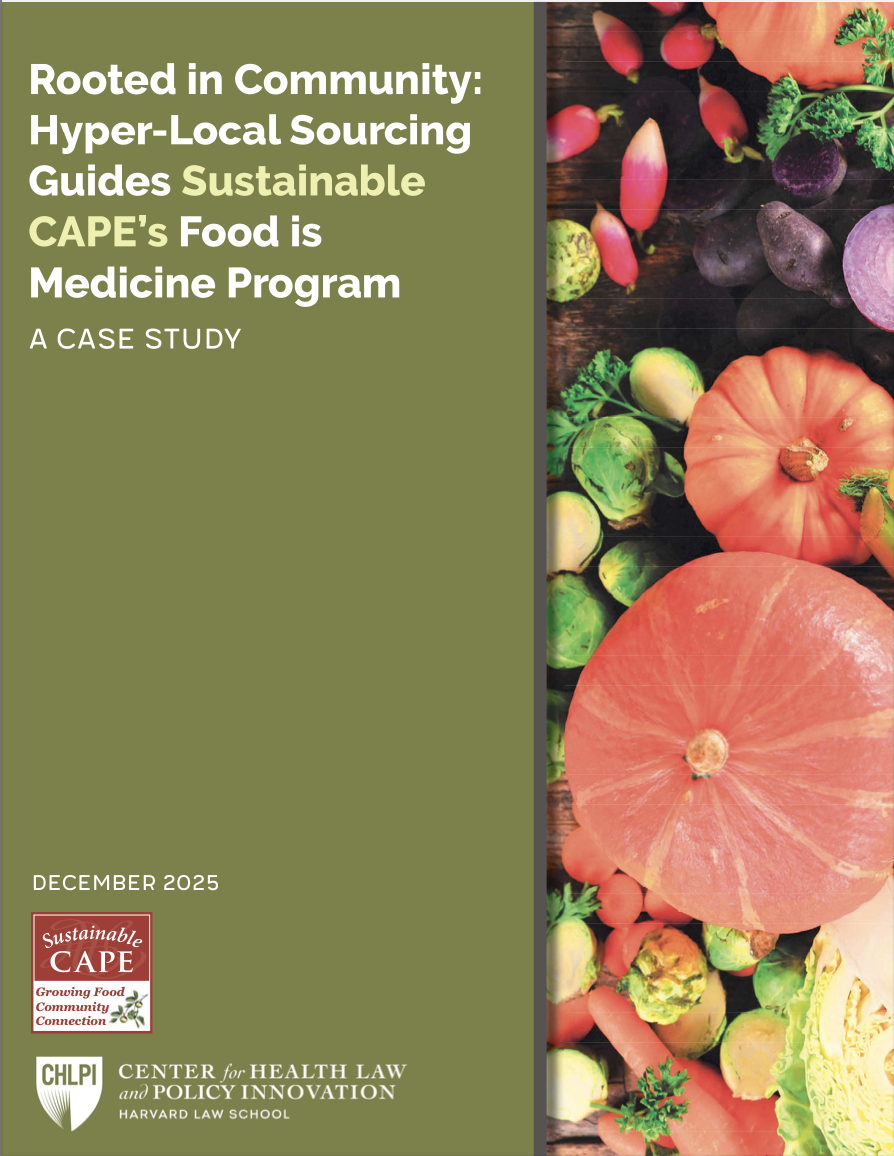
Harvard’s Center for Health Law and Policy Innovation and Sustainable CAPE released a case study titled, “Rooted in Community: Hyper-Local Sourcing Guides Sustainable CAPE’s Food is Medicine” that explores the medically-tailored grocery boxes Sustainable CAPE provides Cape residents through its Food is Medicine program. With a focus on hyper-local sourcing, Sustainable CAPE’s grocery boxes bring healthcare dollars into the local community- every $1 generates an estimated $1.40-$1.53 in economic activity- and connects patients to fresh produce, produce that often comes straight from the fields. The case study explores how Sustainable CAPE expanded their program and overcame obstacles. Ultimately, the case study offers advice to similar organizations on how to integrate values into their purchasing decisions.